We’ve provided several answers to questions related to Adhesives and Underlayment , see some other helpful Q&A related to this product.
-
Question: Do you need to tape the underlayment at the perimeter of the room or just at the seams?
Answer: Just tape the seams. You want the perimeter to be open to allow airflow through the fibers to help manage and mitigate moisture.
-
Question: Can I use the MP Moisture Block with real wood floors? I see the package only says laminate and engineered.
Answer: If you are referring to solid hardwood floors, you may use All Globe Inc, Silicone Vapor Shield for Hardwood Floors or MP Global, QuietWalk Plus - without Antimicrobials. Follow the installation instructions for the specific product which are located on the right side of the product page under Downloads.
-
Question: Can I use QuietWalk with Moisture Block and Lifeproof floor over concrete? I understand the Lifeproof warranty issue.
Answer: QuietWalk Plus and Moisture Block are meant to be used separately. Not together. You need to reach out to the Lifeproof brand (we do not sell or support vinyl, like Lifeproof) in order to find out if either one of those will work under it and be allowed for use.
-
Question: Can this be used on unsealed concrete that has in floor heating in the concrete?
Answer: It says at the bottom of the page under Specs, "Radiant Heat -- Okay for use with electric or hydronic radiant heat ".
-
Question: HELP! We have a 2 inch pine T&G floor in our cabin that doubles as our floor and subfloor over an unheated crawl space. We suspect mold is coming up from the crawl space and need to seal off the pine floor. We would like to put cork down ... what barrier do we put down over the pine and under the cork? The pine floor is finished with 3 coats of Ecos paints brand tinted varnish.
Answer: If you suspect mold is coming up from the crawlspace, my recommendation would be to first, check to see if that's actually the case. If it is, remediate the mold before doing anything and lay a moisture barrier on the ground beneath the subfloor. If you choose to use a moisture barrier between the subfloor and the cork you wish to install, I recommend Quietwalk Plus. Please see manufacturer installation instructions regarding the floor and the underlayment on our website.
-
Question: Hi, So I am looking to put down carpet tiles that I got online in my rental apartment but notified that the most recent ones I ordered did not come with a rubber backing and was looking at this product as a potential solution. The reason for this project is to protect the hardwood floors I have underneath as I have a cat that is in her senior years and is bound to have future mishaps. Would this help to protect my wood floors underneath from cat urine?
Answer: The Moisture Block will certainly protect the subfloor from pet urine. However, you can't glue the carpet over it. If you are floating these tiles, then this will work. Otherwise, you will need to find a waterproof glue.
-
Question: Can it be used on walls as a vapor barrier?
Answer: No
-
Question: I'm looking at marmoleum or cork for our small kitchen floor redo. Do I have to use a vapor barrier before I put down any flooring?
Answer: It depends on what you are placing the Marmoleum or Cork flooring on top of. In a general sense, if your click floor is going over concrete or ceramic, yes you should use a vapor barrier. If going over plywood or a previously installed wood or vinyl floor, the vapor barrier is optional. Specific details to this effect are spelled out in the installation guidelines for whichever floor you choose. Glue-down/sheet flooring installation would have different instructions.Installation instructions for all our floors is located on the product detail page under Downloads, which is to the right of the overview text and directly below the "add to cart" button.
-
Question: Is MP Global, Moisture Block Item #15636 6mil in thickness?
Answer: Yes, this is a 6 mil vapor barrier.
-
Question: Does this product contain any biocides, fungicides, mildewcides or flame retardants? Is it 100% polyethylene? Is it made with recycled materials?
Answer: According to MP Global, there are no biocides, fungicides, mildewcides or flame retardants added to the product.
-
Question: Does it have any adhesive on it to make it stick?
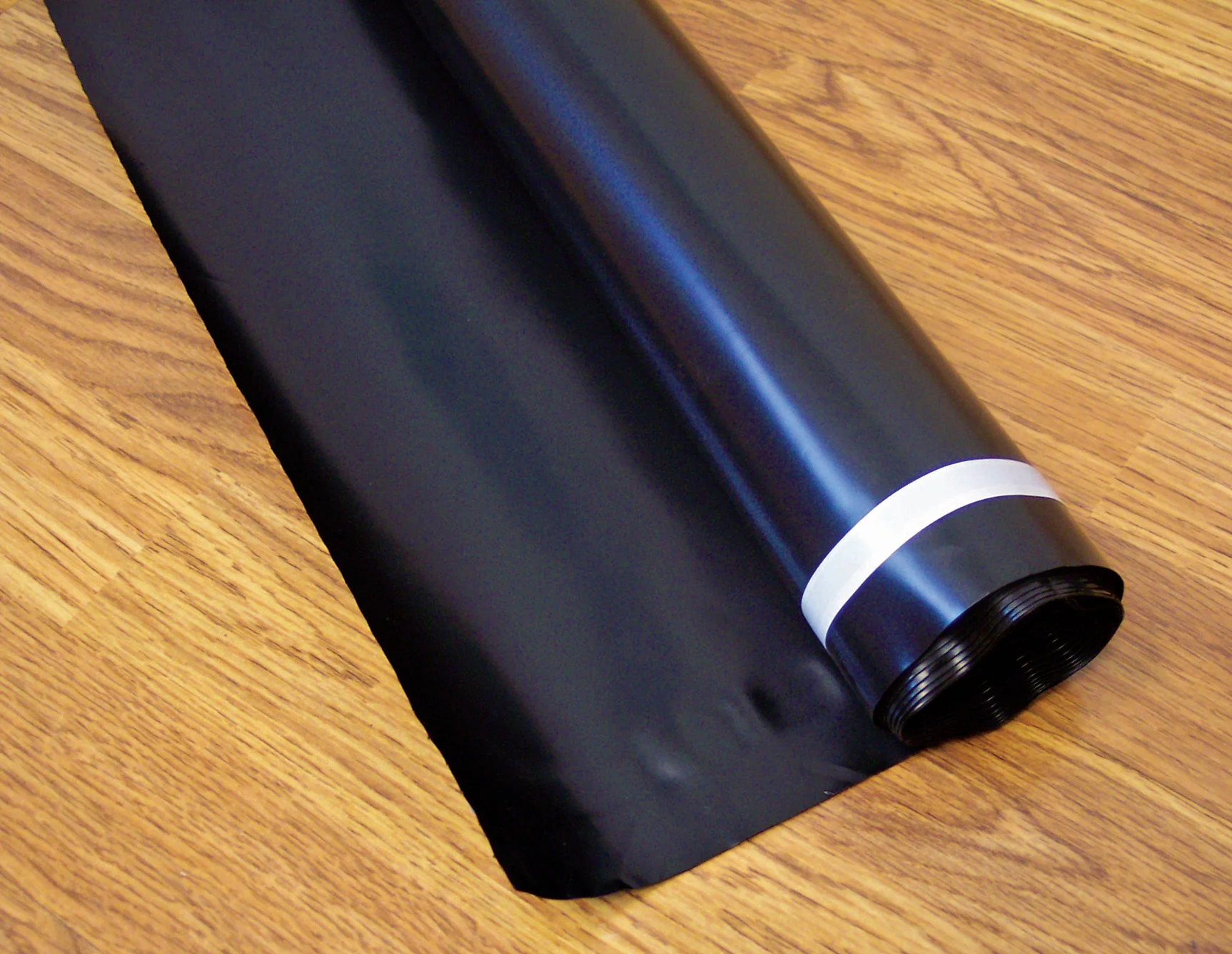
Answer: It's got a self sealing seam (a strip of adhesive), you see that white stripe in the product photo? that is what that is. This is designed to adhere to additional sheets of Moisture Block, which makes it simple to connect and form a continuous 6 mil vapor barrier whatever the size of your floor.
-
Question: Would this be sufficient to cover the dirt floor of a crawl space?
Answer: Sure. You could go this route to cover your crawl space dirt floor.
-
Question: Would this work for an earthen floor vapor barrier w ground and gravel/sand as subfloor?
Answer: MP Global Moisture Block was not intended for sand and gravel and would probably tear under foot pressure. Generally a much thicker vapor barrier is required for earthen floors or for crawl spaces.Moisture Block was designed for flat smooth solid subfloors such as plywood or concrete.
-
Question: My subfloor is 1x6 boards mostly, with plywood replacement at damaged/ remodeled areas. Can this go over that underneath new red oak 3/4" hardwood strips?
Answer: Moisture block is made to be used as a vapor barrier beneath any floating hardwood, bamboo, cork or linoleum floating floor. However, if you are nailing 3/4" red oak, then this would not work. A better product would be our Silicone Vapor Shield which is a vapor retarder made for nail down floors.
-
Question: We are planning to install Marmoleum click tiles and panels in the kitchen, bathrooms, and laundry room of our cabin. The rooms are small and oddly shaped and we wondered whether Moisture Block needs to seal at the edges of the room? We will likely need to use self-leveler in some areas as well to ensure that the floors are flat enough for installation, should we order cork instead?
Answer: Quietwalk Plus would be our recommendation here, it will cover all the bases (light pun intended) as it will help with subtle leveling, insulate, and provide a moisture-wicking barrier between the Cinch Loc and your subfloor.
-
Question: I'm making 16.5" high raised cedar planting beds for vegetables. Is MP-Global-Moisture-Block safe to use to line the inside of the planting bed (to block moisture from the cedar wood planks)? Is it safe for the soil and vegetables to stay in contact with this lining?Also, is this product still bio degradable? How often should I replace this lining?Or, this product is not designed for outdoor use in this way?
Answer: AFM's DynoSeal is what you want. That is our number one recommendation for wood planters beneath the soil. It will protect the wood from rotting and will not leech anything harmful into the soil or plants.Above the soil line, you can paint using AFM Exterior Satin Paint or Stain with Vermont Natural Coatings PolyWhey Exterior Stain.Your idea for using Moisture Block in this fashion is well outside the range of what the Moisture Block was developed for, which is going under flooring.
-
Question: I am putting radiant flooring in a small bathroom. I am going to put QuietWalk Plus over the radiant heating and under the tile. Do I also need Moisture Block (on the subfloor under the radiant heat)? This is for a cabin with just a crawl space underneath. Thx!
Answer: You will want to follow the manufacturer's instruction for the tile and what they suggest for underlayment. However, in general, a person need not use both.
-
Question: I have excess moisture in my living room and dining room concrete floor approximately 600 sq feet.I installed pergo gold underlayment with 10xmoisture protection barrier. And laminate flooring But after a couple months months im having major mold mildew odor coming from my floor.What to do!!?!???
Answer: Excessive moisture can come from many sources: condensation, leaky walls, hydrostatic pressure or all of the above. There could be different solutions to each of these.The source of the moisture must be uncovered and mitigated first and that will fix your mold problem.
-
Question: How far up the edge of the wall do I go with the black vapor barrier?
Answer: According to the manufacturer's instructions, there is no need to go up the wall.INSTALLATION INSTRUCTIONS�?� Always read the flooring manufacturers recommendations and instructions before installing the underlayment.�?� Before rolling out the underlayment, be sure to sweep, vacuum, and remove all debris on the substructure.�?� Fill in any significant holes, gaps or breaks that may exist on the substructure.�?� Roll out the Underlayment over the substructure surface.�?� Splice each roll of underlayment with a 3 mil tape, duct tape, or similar pressure-sensitive tape that meets/exceeds the water vapor transmission ratings suggested by the flooring manufacturer.�?� If installing MoistureBlock Film Underlayment with Self-Sealing film edge, simply connect the rolls by removing the liner from the tape and adhere to the edge of the previous roll.�?� Always be sure to connect the film rolls together with the adhesive tape evenly so that there are no gaps between the adjoining rolls of film.
-
Question: I have a condo with above grade concrete floors. Would I be able to apply this moisture block on the concrete then install my wood floors directly on top of it? It is solid hardwood. I don't plan on using a plywood subfloor (plywood has toxic chemicals and I'm not interested in going through the off-gassing process).
Answer: Assuming this is a solid 3/4" hardwood floor, it should be nailed to a plywood subfloor or glued to a concrete subfloor. Generally, solid hardwoods are not floated over concrete. If it is floated, then use our QuietWalk Plus underlayment and vapor barrier. Always consult the manufacturers instructions first.Regardless of which installation method is used; to prevent the build up of moisture and mold, we recommend sealing the concrete prior to installation of the floor with our GBS Penetrating Concrete Sealer. This will strengthen the concrete, reduce hydrostatic pressure, mold, spawning, efflorescence and keep your floor dry. This is far better than using Moisture Block which will only trap moisture beneath the plastic and potentially create an environment for mold to grow.If gluing, use our DriTac Golden Bullet zero VOC adhesive.
-
Question: Can this be used to cover exposed insulation?
Answer: Yes, this is simply 6 mil polyethylene. It has no odor and is zero VOC. It comes in rolls of 100 SF. The white tape is removed which reveals an adhesive that allows one row to overlay the next without the need for tape. This is a vapor barrier that is NWFA approved with a perm rating of .1 or less.
-
Question: I like to know if you have a 'green moisture barrier' for a floating floor. The Room is 180 sq feet. I'm also concerned about the bamboo creaking a bit?
Answer: Most all bamboo flooring manufacturers require both a vapor barrier and an underlayment beneath their flooring for warranty purposes. Always refer to their installation guidelines as they are not all the same. For most of our bamboo floating floors, we recommend Quietwalk. This has a moisture barrier and underlayment, all in one. It's also non-toxic, zero VOC and has no odor. It's been specially made for Green Building Supply without any biocides, fungicides or antimicrobials. It comes in 100 SF rolls, 1/8" x 3' x 33' 3", and has a peel off tape that exposes some adhesive that allows you to overlap the seams to seal each row without the use of duct tape. The QuietWalk has an excellent sound deadening capability which is why its called QuietWalk. It has an impact resistance and overall acoustical rating that is better than cork. If your bamboo creaks when you walk on it, it may be caused by the joints rubbing against one another. That may be due to an uneven subfloor, which is usually the case, or lack of expansion space around the perimeter. No underlayment can prevent creaking completely if the subfloor is uneven, but underlayments are designed to smooth out the subfloor which will help reduce the rubbing significantly.
-
Question: Wondering what your recommendation is for underlayment for cork click type, floating flooring. it's new construction, concrete slab (not heated), single story. My understanding is that moisture barrier is all that's needed. Is that correct? What's your recommendation?
Answer: Each cork manufacturer has different installation guidelines which must be followed. Most require no moisture barrier on a first or second floor, however, a moisture barrier is required on a first floor if over a crawl space or unheated basement. Moisture barriers are designed to prevent excessive moisture from getting into your cork flooring. We offer a 6-ml polyethylene moisture barrier called Moisture Block. It is non toxic and has no odor. It is 36in wide x 33ft long (100Sf/roll) and requires nothing extra to seal the seams because it comes with a pull-off strip that exposes adhesive on the edge and allows you to overlap the seams without tape. Nice! If you prefer a little more cush beneath your cork flooring, you can also use our QuietWalk which is an underlayment and moisture blocker all in one. It is also 3ft x 33ft (100 SF/roll) and requires no tape either. Both the Moisture Blok and the QuietWalk are non-toxic and have no odor.