2010-6-24-GBS-LOGO

 
Contact Us
Log In
 
  
Air and Water Purification
  
Natural Flooring
  
Non-Toxic Finishes
  
Environmentally Friendly Cleaners
  
Eco-Cabinets, Countertops, Millwork
  
Wool & Recycled Carpeting
  
Energy & Water Conservation
  
Outlet
 

WHAT'S NEW?

Garden Composter
SunMar Garden Composter 200 girls

Venetian Clay Paint Zero VOC

Bioshield Venetian Group 9,10

Deck/Dock coating very long lasting

UDF-21 reconditioned dock

Amazing non-toxic German all-purpose cleaner 

Universal Stone 500g container

 Caroma Profile high efficiency toilet and sink--saves even more water!!!
Caroma Profile suite sm

Velux Solar Hot Water

Oil-based Paints are back; This time they are Organic!

AFM Naturals Paint

Serious  Zero VOC Commercial Grade Caulks and Sealants
 

Non-toxic, ultra low VOC, Stain + Polyurethane for floors, doors, woodwork

Bioshield, 022 Dark Cherry, Aqua Resin floor finish 

 Stunning Pre-fabricated Bamboo Countertops

Deep Penetrating Colored Sealers for Concrete &Stucco


Home
Products
How to Order Samples
Non-toxic Cabinetry
Bamboo Countertops
Richlite Recycled Countertops
PaperStone Recycled Countertops
Vetrazzo Recycled Glass Countertops
Marmoleum Countertops
Marmoleum Wall Panel System
Bamboo Millwork
Molding
Stairs
Interior Doors
Kirei Board, Bamboo Plywood, Wheatboard
Teragren Bamboo Plywood
Bamboo Furniture
Bamboo Kitchen Accessories
Contact Us 800-405-0222
Shipping, Ordering & Returns
Comments
Site Map
Log In

Bamboo Flooring Installation guidelines


FOR SOLID BAMBOO FLOORING

A. Site Preparation

Inspection: Carefully inspect all material before installation. Any material installed with visual defects will not be warranted. 
 
Timing: In new construction, bamboo flooring should be the one of the last items installed.  All work involving water or moisture (plumbing, drywall, etc) should be completed prior to bamboo flooring installed.  Flooring should not be delivered until the building has been closed in and cement work, plastering, painting, and other materials are completely dry.  Concrete and plaster should cure at least 60 to 90 days.  Check basements and crawl spaces to be sure that they are dry and well ventilated to avoid damage caused by excess moisture.

Flooring should be on job site at least 72 hours BEFORE installation.  Installation site should have consistent room temperature of 60 - 75 degrees Fahrenheit and a constant relative humidity level of 40 - 60% for a minimum of five days prior to installation and maintained thereafter.  The relative humidity of any room can be checked using a Hygrometer.

Surface Preparation: Sub floor surface must be clean, dry, smooth and free of cleaning agents, dirt, wax, oil, paint, concrete Sealer, curing agents and other contaminants that would interfere with an adhesive bonding. Old resilient floors can be installed over, provided above conditions apply. Wood sub-floor joints must be sanded level prior to new installation. Concrete sub-floors must be level and have all cracks and holes filled with a concrete patching material.
  
While bamboo flooring is more stable than most wood, it is still subject to damage when in direct contact with a wet slab. The bamboo must be isolated from this type of slab by use of a floating floor system over a non-absorbent pad such as our SCI Titanium. Urethane adhesive may fail when vapor pressure exceeds 3 pounds per 1000 square foot in 24 hours and therefore bamboo flooring cannot be glued down under those conditions. Check urethane manufacturer directions and warranty for details.

Wood Sub Floor: Sub floors made of wood should not exceed a moisture content of 12%.  If a moisture content exceeding 12% exists, the cause of excess moisture conditions must be determined prior to installation.

Concrete Sub Floor:  Test for presence of moisture in the sub floor with a 3' x 3' piece of polyethylene film taped along all four sides directly to the sub floor.  Wait 24 hours, then check for the appearance of condensation on the inside of the film or a darkening of the concrete sub floor.  Either occurrence signals the likely presence of excess moisture, requiring a calcium chloride test (3 lbs. Per 1,000 square feet in 24 hours is the maximum moisture that can be present).  If moisture is present

Ventilation:  Homes with crawl spaces and pier-beam foundations must have vents for proper cross ventilation.  A minimum guideline for year round air circulation is multiple vents with a total area equal to 1.5% of the area of the crawl space.  Vents must be adequately spaced so that no dead air spaces remain.  An additional moisture barrier is strongly recommended under the home to guard against excessive moisture.  Lay a 6-mil polyethylene barrier directly against the ground in the crawl space to reduce the problem.

B: Installation

General: May be stapled or glued down over wood sub floors or glued directly to concrete sub-floors, above or below grade surfaces (if installed below grade we recommend using our "3 in 1" membrane). Where moisture, acoustics, and or sub floor fractures may be of concern, flooring may also be glued, stapled, or floated (wide planks only) over our "3 in 1" membrane. For all types of installation, joints must be staggered 10"to 20".  We recommend bridging the flooring across the floor joist.  NOTE: We do not recommend installing over or onto particleboard, (OSB is the only exception to this rule).

Nailed down:  Use a 15 pound felt paper over the sub floor, this should run with the floor joist.  Planks should be started square with the room and parallel to its longest dimension by positioning with a chalk line, leaving 1/4" expansion joint from the base plate or wall. Make sure the starter rows are firmly in place by wedging or face nailing. Once initial rows are secure, second and further rows should be blind nailed directly above the tongue at a 45 to 50 degree angle to the face. 2" or longer fasteners should be spaced at 10 to 12 inch intervals with a minimum of two fasteners per piece.

Glued down:  When moisture conditions exist now or in the future, use a moisture barrier wood flooring adhesive like "Bostik's BEST' or HealthyBond.  The glue must be 100% urethane. Check with glue manufacturer for warranty information and installation instructions as bamboo manufacturer does not warrant the glue.  Spread the glue with a 1/4" x 1/4" notched trowel. Inspect each board before installation. Planks should be started square with the room and parallel to its longest dimension by positioning with a chalk line, leaving 1/4" expansion space from the base plate or wall. Make sure the starter rows are firmly in place by a wedge or spacer. Once initial rows are secure, use adhesive in a "Wet-Lay" method of installation (refer to the glue manufacturers instructions). Remove spacers once the job is complete.

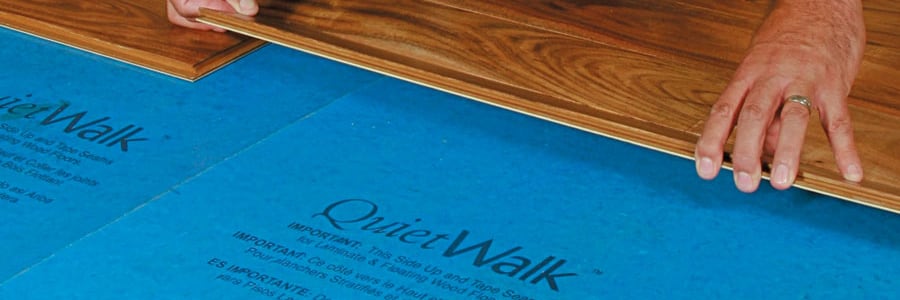
Tongue and Groove Floating (plank, wideboard, engineered or veneered plank 72"x 6 3/8"x 5/8" only):  Install underlayment over cement sub floor. We recommend either 6 mil polyethylene as a moisture barrier and then our SCI underlayment (go to the underlayment section and see all types).  Follow manufacturer's installation instruction for installing underlayment.  DO NOT open bamboo flooring packages until you are ready to begin installation.  Opening packages to acclimate the floor could result in a difficult installation.  Inspect each board before installation.  Lay down the first board at the right end of the starting wall with the tongue facing toward you.  Be sure to leave 1/2" wide space between the floor and wall.  You can use expansion shims at 12" intervals. 

Apply a continuous 1/8" thick bead of wood glue (Kahrs floating floor glue is best) to the top inside of the grove (long and short side) of each board.  Never apply glue to the tongue or fill the groove.  Place the tapping block against the tongue side of the board and tap with a non-marring mallet or hammer.  Never hammer on the grooved side.  Make sure all joints are tight.  Immediately wipe off excess glue with a damp cloth.  Start each new row on the right side with the remaining portion of the previous board that has been cut.  The end joint must be at least 20" from the end joint in the row before it.  When you get to the last row, it will most likely require that you rip the board lengthwise. To measure the last row, place a board directly on top of the last installed row of the boards.  Scribe the row and cut to fit.  Use the last board puller to position the boards together.

Moldings: Do not glue or nail moldings to your floor.  Transition moldings are glued to the sub floor and perimeter moldings are nailed to base molding or wall.  Remove excess underlayment before placement. Allow the glue to dry overnight (at least 12 hours) before heavy use of the floor.


Comments Email Print


 Air and Water Purification  |  Natural Flooring  |  Non-Toxic Finishes  |  Environmentally Friendly Cleaners  |  Eco-Cabinets, Countertops, Millwork  |  Wool & Recycled Carpeting  |  Energy & Water Conservation  |  Outlet 

fullpartner-footer-newletter.pngfullpartner-footer-facebook2.pngfullpartner-footer-twitter2.png

508 N. 2nd Street, Fairfield IA 52556         

Call Toll Free:

1-800-405-0222       Fax: 515-864-0005
Showroom Hours: M-F 9AM to 5PM CST    Sat. 9:30-1PM

Click here to contact us!

Where EARTH DAY is every day!

© 2010 Green Building Supply   All Rights Reserved.

*